
Download Ovulation Tracker by Saifosys Android App for more Articles on Women Health
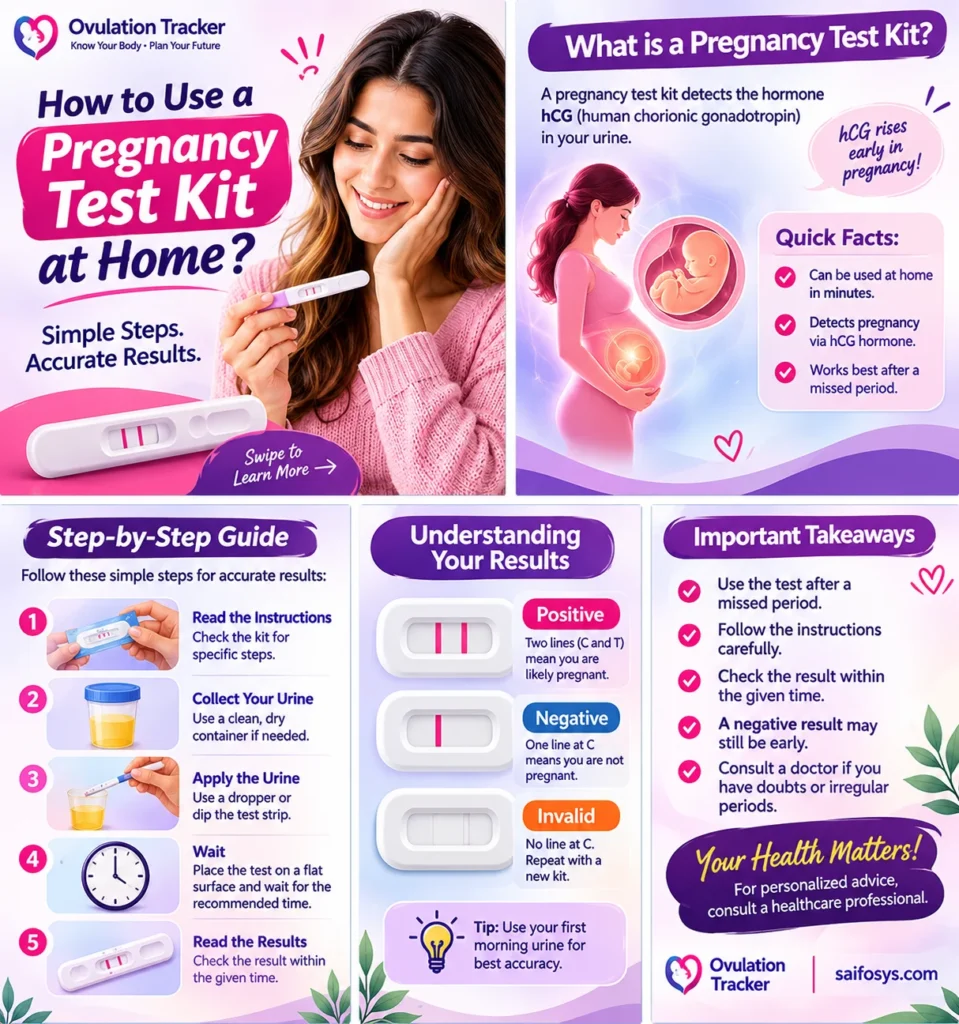
A pregnancy test is one of the easiest ways to check whether you may be pregnant. Home pregnancy test kits are widely available at pharmacies and are designed to detect a hormone called human chorionic gonadotropin (hCG) in your urine.
However, knowing when to take the test, how to use it correctly, and how to interpret the results is important for getting reliable information.
In this guide, we explain everything you need to know about using a pregnancy test kit at home.
1. What Is a Home Pregnancy Test?
A home pregnancy test is a simple testing device that detects hCG (human chorionic gonadotropin) in urine.
Your body starts producing hCG after a fertilized egg implants in the uterus. The hormone level increases during early pregnancy.
Most home pregnancy tests detect hCG and display the result using lines, symbols, or a digital message.
Why use a home pregnancy test?
- It is convenient and easy to use.
- It can provide results within a few minutes.
- It offers privacy.
- It can help you identify a possible pregnancy before visiting a healthcare professional.
2. When Should You Take a Pregnancy Test?
Timing is important when taking a pregnancy test.
For most home pregnancy tests, the best time to test is from the first day of your missed period.
Testing too early may produce a negative result even if you are pregnant because your hCG level may not yet be high enough for the test to detect.
Tips for choosing the right time:
- If your period is regular, test from the first day of your missed period.
- If you do not know when your period is due, consider testing at least 21 days after unprotected sex.
- If you are testing early, first-morning urine may improve the chance of detecting low levels of hCG.
- Avoid drinking excessive amounts of water immediately before testing, as diluted urine may affect detection.
Some sensitive tests can detect pregnancy earlier, but early results are less reliable.
3. What Do You Need Before Taking the Test?
Before starting, prepare:
- A home pregnancy test kit.
- A clean, dry urine collection container if required by your kit.
- A clean, flat surface.
- A timer or clock.
- The manufacturer’s instruction leaflet.
Important: Check the expiry date and packaging before using the test. Do not use a damaged or expired kit.
4. How to Use a Pregnancy Test Kit at Home: Step-by-Step
Different pregnancy test kits have different instructions. Always follow the specific instructions provided with your kit.
Step 1: Read the Instructions
Open the package and carefully read the manufacturer’s instructions.
Check how to collect urine, whether the test should be dipped or held in the urine stream, and how long you should wait.
Step 2: Collect Your Urine
Depending on the type of test, you may need to collect urine in a clean, dry container or hold the test directly in your urine stream.
First-morning urine can be helpful, especially when testing early.
Step 3: Apply the Urine
Use the dropper if your kit requires one, or follow the instructions for dipping the test strip or holding the device in your urine stream.
Do not add more urine than recommended.
Step 4: Wait for the Recommended Time
Place the test on a clean, flat surface if instructed.
Wait for the time specified by the manufacturer. Many tests take only a few minutes.
Do not interpret the result too early or after the manufacturer’s specified reading window.
Step 5: Read Your Results
Check the test window carefully.
Depending on the test design, you may see two lines, one line, a plus or minus sign, or a digital result.
Use the manufacturer’s result guide to understand what the displayed result means.
5. Understanding Your Pregnancy Test Results
Positive Result
A positive result generally means hCG has been detected and pregnancy is likely.
Even a faint second line may indicate a positive result if it appears within the instructed reading time and the control indicator is valid.
Arrange appropriate healthcare follow-up to discuss confirmation and next steps.
Negative Result
A negative result means the test did not detect enough hCG to indicate pregnancy.
However, testing too early can lead to a false-negative result.
If your period still has not arrived, repeat the test after a few days. If you continue to get negative results but your period is absent, consult a healthcare professional.
Invalid Result
A test is invalid if the control indicator does not appear as instructed.
This may happen if the test was not used correctly or the device did not work properly.
Repeat the test using a new kit.
6. Tips for Getting More Reliable Results
Follow these important precautions:
- Check the expiry date before using the kit.
- Read the instructions carefully.
- Test from the first day of your missed period when possible.
- Use first-morning urine if testing early.
- Avoid drinking excessive fluids immediately before testing.
- Follow the recommended waiting time.
- Do not interpret the result after the specified reading window.
- Repeat an early negative test if your period does not arrive.
7. Can a Pregnancy Test Be Wrong?
Yes. Although home pregnancy tests are generally reliable when used correctly, incorrect timing and improper use can affect the result.
Possible reasons for a false-negative result:
- Testing too early.
- Low hCG levels.
- Diluted urine.
- Not following the instructions.
- Reading the result incorrectly.
Possible reasons for a false-positive result:
- Certain fertility medications containing hCG.
- A recent pregnancy, including pregnancy loss.
- Rare medical conditions that produce hCG.
If your result is unexpected or confusing, speak with a healthcare professional. They may recommend another urine test or a blood pregnancy test.
8. When Should You Contact a Healthcare Professional?
Contact a healthcare professional if:
- Your period is missed but pregnancy tests remain negative.
- You receive repeated unclear or invalid results.
- You have a positive result and need guidance about your next steps.
- You experience unusual bleeding or persistent abdominal discomfort.
Important warning: If you might be pregnant and experience severe or one-sided abdominal or pelvic pain, shoulder-tip pain, fainting, dizziness, or heavy bleeding, seek urgent medical assessment. These symptoms can sometimes indicate an ectopic pregnancy or another serious condition.
Do not wait for another home pregnancy test if you have severe symptoms.
9. Frequently Asked Questions
Q1. Can I take a pregnancy test at night?
Yes. Many tests can be used at any time of the day. However, first-morning urine may be more useful when testing early because it is often more concentrated.
Q2. How many days after unprotected sex can I take a pregnancy test?
If you do not know when your next period is due, testing at least 21 days after unprotected sex is a useful guideline.
Q3. Can a faint line mean pregnancy?
Yes. A faint second line may indicate pregnancy if it appears within the manufacturer’s reading time and the control indicator is valid.
Q4. What if my pregnancy test is negative but my period is late?
Repeat the test after a few days. If your period still does not arrive, consult a healthcare professional.
Q5. Can drinking too much water affect a pregnancy test?
Yes. Excessive fluid intake can dilute urine and make hCG harder to detect, particularly in early pregnancy.
Q6. Do all pregnancy test kits work the same way?
No. Some require urine drops, some are dipped into collected urine, and others are held directly in the urine stream. Always follow the instructions for your specific product.
Q7. Should I visit a doctor after a positive pregnancy test?
It is advisable to arrange healthcare follow-up after a positive home pregnancy test to discuss pregnancy care and appropriate next steps.
Conclusion
Using a pregnancy test kit at home is simple when you understand the correct timing and instructions.
For more reliable results, test at the appropriate time, follow the manufacturer’s directions, and read the result within the specified time window.
Remember that a home pregnancy test is an initial screening tool. A healthcare professional can help you understand your result and guide you through the next steps.
Your health matters. Stay informed, stay confident, and take care of yourself.
Follow Ovulation Tracker for more women’s health and reproductive health education.
Download Ovulation Tracker by Saifosys Android App for more Articles on Women Health
Medical Disclaimer: This article is for general educational purposes only and is not a substitute for professional medical advice, diagnosis, or treatment. Follow the instructions supplied with your pregnancy test and consult a qualified healthcare professional about your individual circumstances.
 in your urine. However, knowing […])